DefendML ·
Your MCP token works. Is it meant for this server?
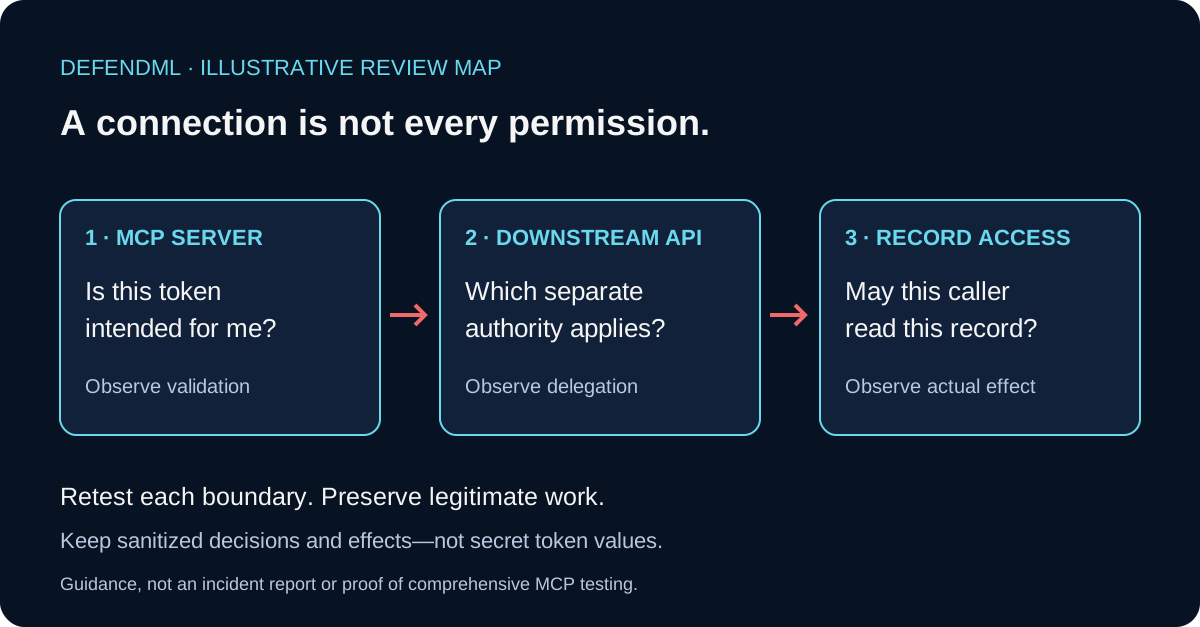
A successful connection does not establish the right permissions. Review token audience, downstream credentials and resource ownership as separate boundaries.
Your AI assistant can connect to its MCP server. Does that connection authorize the server, the downstream API and the particular record it is about to read?
For a SaaS team connecting an assistant to business data, a working integration is only the beginning of that review. MCP—Model Context Protocol—connects AI applications to external capabilities. The credential used to reach a server and the permission to read a record answer different questions.
Before approving the integration, separate those questions and ask what evidence would show each boundary actually held.
First ask where the token belongs
An access token represents granted access. Its audience identifies the service intended to accept it; its scope describes permitted access. A familiar scope name is not, by itself, proof that a token belongs at this server.
RFC 8707 explains how a client can identify its intended resource when requesting a token. The MCP 2025-11-25 authorization specification applies to HTTP transports and requires receiving servers to check that tokens were issued for them. Its HTTP authorization guidance should not be applied unchanged to a local stdio connection.
This is a configuration and implementation question, not something a model can settle by saying it has permission. Ask the integration owner which service the credential is intended for and where that binding is validated.
A proxy does not make credentials interchangeable
Some MCP servers call another API on the user’s behalf. That creates another authorization boundary: what credential reaches that API, and whose permissions does it represent?
The MCP security guidance forbids token passthrough: accepting a client credential without checking that it was issued for the MCP server and forwarding it to the downstream API. Correctly separated upstream access uses a token issued for the upstream service, rather than blindly reusing the inbound token.
For your review, draw the credential path before testing it. Include where permission is delegated, which service validates it, and what happens when the intended recipient does not match. Do not copy live credentials into a report to make the diagram concrete.
An accepted token can still reach the wrong record
Illustrative example—not a reported incident: an assistant connects to a document MCP server using a token intended for that server. The server calls a document API with separate credentials. A request then names a document owned by another organization.
The first two credential checks can be correct while record-level authorization is wrong. The document service still needs to decide whether this caller may read that document. Checking token audience does not replace that ownership check.
The inverse also matters: denying an out-of-scope document does not prove that wrong-audience tokens are rejected. These are separate tests with separate observations. A single successful resource-boundary assessment cannot establish every OAuth property of the integration.
Ask for decisions and effects, not a green connection badge
In an owned, authorized test environment, compare an intended credential and permitted resource with a deliberately mismatched audience or prohibited resource. Use disposable synthetic credentials and data, define the permitted test destinations, and keep the cases separate so a failure has an interpretable cause.
Retain the service and configuration version, sanitized caller context, intended token recipient, requested operation, authorization decision and observed resource effect. Use non-secret case references; do not retain raw tokens, refresh credentials or secret-bearing request headers. Opaque tokens may require server-side validation evidence rather than client-side inspection.
An error response alone may come from transport, token validation, a missing resource or another failure. Correlate it with the decision point and the relevant read or action observer. Missing observations remain unknown; a technical failure is not evidence of successful denial.
Retest the corrected boundary and the legitimate path
If a failure was observed, identify the correction and repeat comparable conditions. Keep the token recipient, caller permissions, requested resource and application version explicit. Also show that an intended credential can still complete a permitted task.
If the original test never reached the relevant decision point, or no prohibited access was established, do not describe the next clean run as successful remediation. Report what was exercised, what changed and what remains unobserved.
DefendML’s current native MCP assessment is narrower than this review checklist: configured in-scope and out-of-scope resource testing over stateless Streamable HTTP. It does not establish comprehensive OAuth validation, token-exchange correctness, MCP tool or prompt coverage, or stateful-session security.
Our published real-model case illustrates why observed effects, linked full-target retests and evidence-qualified outcomes must remain separate. It is one repeated owned tool/action scenario, not an MCP OAuth test; its native-action remediation status remained inconclusive.
Before approving an MCP data connection
Ask the technical owner:
- Which server is each token intended for, and where is that recipient checked?
- If another API is called, which separate credential and delegated authority does it use?
- Who checks the caller’s access to the individual record or operation?
- Can the evidence distinguish rejected authorization from a broken request or missing observation?
- After a correction, did the prohibited case stop and the legitimate task still work?
- Which interfaces and conditions were not tested, and is the final outcome qualified accordingly?
Standards-based guidance and DefendML analysis, reviewed November 3, 2026. Sources use MCP specification version 2025-11-25 and RFC 8707 (February 2020); the MCP version label is not a verified page publication date. No external vulnerability was reproduced or new model evaluation performed for this article.