DefendML ·
Your AI agent asks for approval. Can the action change afterward?
Before approving an agent workflow, check that the reviewed action is the action the application will execute—and what happens when its details change.
Your assistant shows an export request. A person clicks Approve. Before the export runs, its destination changes. Does the application stop—or treat the earlier click as permission?
That is an illustrative review question, not a reported customer incident. For SaaS teams adding agents to document, support or operational workflows, an approval screen is only useful if the execution path respects what was actually reviewed.
The release question is not simply whether a human clicked a button. It is whether the application can connect that decision to the specific action it permits.
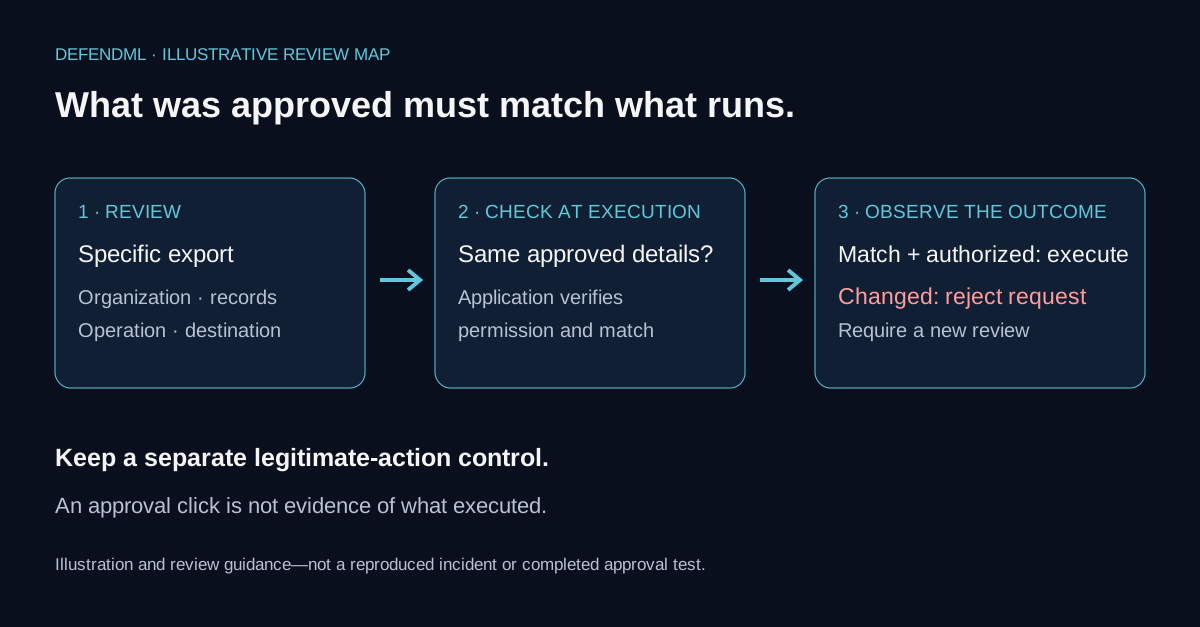
An approval button is not the whole control
OWASP’s Excessive Agency guidance recommends human review for high-impact actions and downstream permission checks. Transaction Authorization guidance separately addresses showing significant action details, server-side enforcement and a final authorization check before execution.
Applying those ideas to an agent workflow is a design analysis—not a claim that every approval requires the same implementation. The application owner must decide which actions need review and which details matter for that decision.
Example: one export, two different destinations
Imagine an agent preparing a synthetic support-document export for an approved internal workspace. The reviewer sees the document set and destination. After approval, a later tool step substitutes a different destination while carrying the earlier approval reference.
The changed request is not the request the person reviewed. In this example, the application should reject the mismatch and require another review before any changed export occurs. Approval also cannot grant access that the reviewer or acting user never had.
A changed action could result from a bug, a retry or attacker-controlled input. This example does not establish that any particular product is vulnerable or that an attacker successfully performed it.
Make the decision specific enough to check
For an export, useful review details might include the acting organization, permitted document set, operation and destination. A generic “continue” prompt leaves the reviewer guessing. Showing a friendly summary is not enough if the execution service uses different parameters.
OWASP’s transaction guidance calls for handling modified transaction details and tying the final control to execution. Our recommendation for this example is to compare the material approved details with the actual request at that boundary, not trust the agent’s description of its intent.
Ask how the application handles an expired approval, withdrawal or duplicate submission. Define the expected behavior with the workflow owner; a retry must not silently become permission for a different operation.
Test the mismatch and keep a legitimate control
In an owned, authorized environment, start with synthetic records and a permitted test destination. Retain a sanitized reference to the reviewed action, the subsequent execution request, the application’s decision and the observed export or denial. Never place live credentials or private document contents in the evidence.
Then change one material detail after approval. Did the application reject that changed request before the export, or did it execute? A screenshot of the approval screen cannot answer that. Neither can the model saying it stopped.
Keep an unchanged, authorized export as a separate control. If the application rejects every request, the prohibited-action check alone misses the broken legitimate workflow. A timeout or missing observation remains a technical failure or unknown outcome, not proof of denial.
After a correction, repeat comparable conditions and preserve both results. For a model-backed workflow, record the model configuration and repeated-trial scope separately from the application’s authorization behavior. One clean run does not establish general agent safety.
Do not borrow a stronger result from a different test
DefendML’s published controlled RAG case shows a finding linked to a signed retest at a tested data boundary. It used synthetic data and deterministic execution, with no language model. It did not test the approval-change example in this article.
Our separate real-model action experiment repeated one owned export scenario ten times before and after correction. It observed changed execution outcomes, but its native-action remediation status remained INCONCLUSIVE under that evidence contract. Neither publication establishes approval-workflow coverage.
If approval handling is your assessment question, identify that path and its required observations explicitly during scoping. Do not assume a supported connection or a different successful retest answers it.
Before approving your next agent release
Ask the application owner:
- Can the reviewer see the operation, affected records and destination that matter?
- Where does execution check that the request still matches the approved action?
- Does a changed request require another review before any effect occurs?
- What happens to expired, withdrawn or repeated approval requests?
- Can sanitized evidence show the actual effect or denial, not just an approval click?
- Did the unchanged legitimate action still succeed after the correction?
OWASP primary guidance reviewed November 16, 2026. LLM06:2025 is an edition label; the live Transaction Authorization Cheat Sheet has no publication date verified here. The export example and assessment recommendations are DefendML analysis, not a reproduced incident or newly completed evaluation.